






If your real return on savings and investments came in below the Belastingdienst forfait, the tegenbewijsregeling lets you pay tax on the actual number instead. For the 2025 tax year it now sits inside the regular aangifte, no separate form. The Wet werkelijk rendement box 3 has slipped to 1 January 2028, and the AG advice from May 2026 looks set to shut the door on non-objectors over 2017-2020. Here's our read on what to do for 2025, the older years still open via OWR, and the run-up to 2028.
Why Box 3 Is the Hottest Tax Topic in the Netherlands Right Now
Box 3 has been a slow-motion legal earthquake since the Hoge Raad's Kerstarrest of 24 December 2021, which held the forfait-based wealth tax in conflict with Article 14 ECHR (non-discrimination) and Article 1 of the First Protocol to the ECHR (right to property). Five years on, June 2026 has produced three developments worth your attention this filing season:
- The tegenbewijsregeling is now in the regular aangifte. For the 2025 tax year (filed between 1 March and 1 May 2026), there is no separate form. You declare your actual return inside the same Mijn Belastingdienst flow you already use.
- The Wet werkelijk rendement box 3 was adopted by the Tweede Kamer on 12 February 2026 and sits with the Eerste Kamer. Effective date has slipped from 2027 to 1 January 2028, and the Minister of Finance has said he wants further amendments before the summer.
- AG advice published in May 2026 said the Hoge Raad should rule that non-objectors over the 2017-2020 years are not entitled to a refund. Objectors are. The final ruling is expected later in 2026.
Everyone with savings or investments above the heffingsvrij vermogen of EUR 59,357 (EUR 118,714 with a fiscal partner) is touched by at least one of these. ZZP'ers building a buffer, expats with foreign assets, and anyone holding ETFs through a Dutch broker all need to look at whether the forfait or the actual return puts them ahead.
Related guides on Taxmo: What's Changing for ZZP'ers in 2026 (Box 1 context) · AOW Pension Age Changes (long-term retirement planning) · BTW Filing Guide (quarterly mechanics for the rest of your aangifte).
Box 3 in 2026: The Numbers You Need to Know
For the 2026 tax year (declared in spring 2027) the Belastingdienst applies a single 36% rate to a forfait calculation of your assumed return. The forfait depends on which bucket your assets sit in.
- Heffingsvrij vermogen, single: 2026 value: EUR 59,357
- Heffingsvrij vermogen, with fiscal partner: 2026 value: EUR 118,714
- Forfait spaargeld (cash and bank deposits, provisional): 2026 value: 1.28%
- Forfait overige bezittingen (investments, real estate, claims, crypto, definitive): 2026 value: 6.00%
- Forfait schulden (deducted, provisional): 2026 value: 2.70%
- Box 3 tax rate: 2026 value: 36%
The provisional rates for spaargeld and schulden are set during the year and only made final after the end of 2026, based on the actual average savings interest and consumer-credit interest rates. The 6.00% figure for "overige bezittingen" is definitive: fixed at the start of the year and does not move (it rose from 5.88% in 2025).
How the math works on a simple example. A ZZP'er has EUR 100,000 in a Dutch savings account on 1 January 2026 and no fiscal partner. After the heffingsvrij vermogen of EUR 59,357 the box 3 assumed return is 1.28% on (100,000 minus 59,357) = EUR 520. The box 3 tax is 36% of EUR 520 = EUR 187. That is the forfait outcome.
Now add EUR 50,000 in an ETF portfolio. Total assets are EUR 150,000. The Belastingdienst calculates a weighted forfait: two-thirds spaargeld at 1.28% and one-third investments at 6.00%. The weighted forfait return is about EUR 4,267. Applied to the EUR 90,643 above the allowance: assumed return EUR 2,578, tax EUR 928. If your ETF portfolio actually rose by 4% over the year, the forfait significantly overstates your return, and that is exactly where the tegenbewijsregeling becomes valuable.
Source: Belastingdienst.nl Box 3 berekening 2026 and the published forfaits in the Belastingplan 2026.
What Is the Tegenbewijsregeling?
The tegenbewijsregeling (counter-evidence rule) lets you ignore the forfait and pay tax on your actual return if the actual return is lower than the forfait. If the actual return is higher, you stick with the forfait. You never pay tax on the higher of the two: this is a one-way safety valve.
What counts as "actual return" in box 3:
- Cash, savings, bonds: interest received during the year.
- Listed shares and ETFs: dividends received plus unrealised gains or losses on the position between 1 January and 31 December. Unrealised losses are deductible.
- Real estate (other than your own home): gross rent received plus or minus the change in WOZ value over the year (or, for foreign property, the change in market value), minus actual interest on debts financing the property. Operating and maintenance costs are NOT deductible against actual return. Improvement and expansion costs are treated as a deposit (storting), not a cost, and the resulting WOZ uplift is excluded from actual return.
- Crypto: realised and unrealised changes in EUR value, treated the same as other investments.
- Claims (e.g. a loan to a family member): interest received.
- Schulden: actual interest paid is deducted from the actual return.
What does not count: notional opportunity cost, currency translation losses on foreign accounts where the underlying is not a tradable asset, and amounts spent during the year (drawdowns are not a loss). The strict no-cost-deduction rule for property is one of the most-litigated points and may itself trigger further procedures.
The key practical rule. You compare the total actual return on your full box 3 portfolio against the total forfait return on your full box 3 portfolio. You cannot cherry-pick by asset class. If your savings beat the forfait but your ETFs were down for the year, the netting may still leave the forfait higher and let you claim relief.
Important caveat for 2026: the actual return calculation includes unrealised gains and losses. A bad calendar year on the stock market can flip your aangifte from "pay forfait" to "claim refund" even if you never sold a share.
Three Worked Examples: When the Tegenbewijsregeling Pays Off
Example 1: A saver with only cash.
Anouk holds EUR 150,000 in a Dutch savings account at 1 January 2026. No partner, no investments. The bank paid 1.10% interest over the year, so her actual interest is EUR 1,650.
- Forfait return: 1.28% on (150,000 minus 59,357) = EUR 1,160.
- Forfait tax: 36% of EUR 1,160 = EUR 418.
- Actual return after allowance: 1,650 x ((150,000 - 59,357) / 150,000) = EUR 997.
- Tax under tegenbewijs: 36% of EUR 997 = EUR 359.
- Refund vs forfait: EUR 59.
Small but real. Worth claiming because the marginal effort inside the aangifte is one screen.
Example 2: A ZZP'er with cash and a falling ETF portfolio.
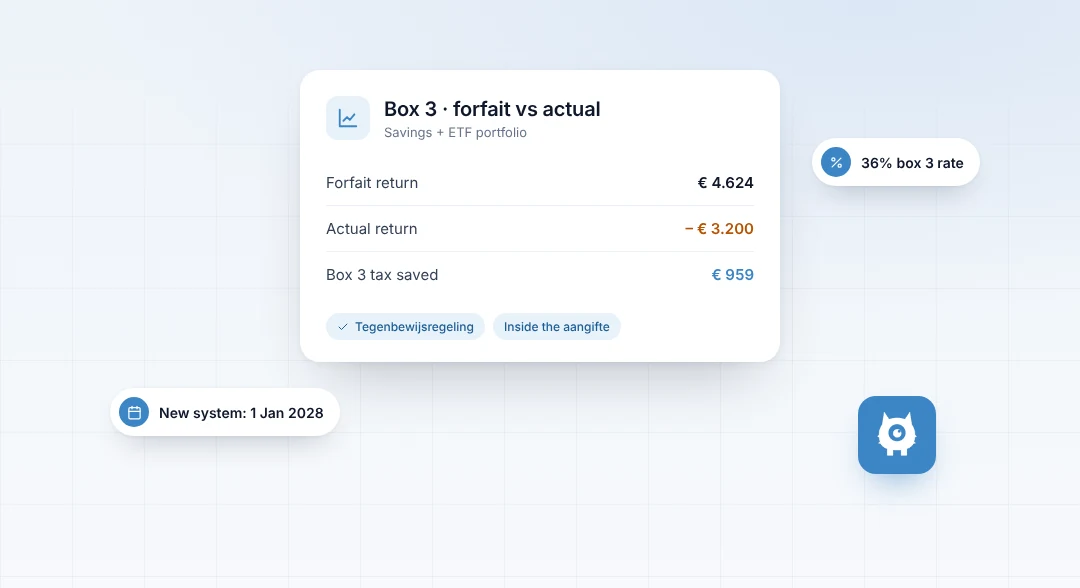
Pieter has EUR 80,000 in savings and EUR 60,000 in a world-index ETF at the start of 2026. He receives EUR 880 in interest. His ETF closes the year down 8%, an unrealised loss of EUR 4,800. He receives EUR 720 in dividends. His total actual return is 880 + 720 minus 4,800 = minus EUR 3,200.
- Weighted forfait return: 80,000 x 1.28% + 60,000 x 6.00% = 1,024 + 3,600 = EUR 4,624.
- Forfait tax after the allowance: 4,624 x ((140,000 - 59,357) / 140,000) x 36% = about EUR 959.
- Tax under tegenbewijs: EUR 0 (negative actual return is rounded to zero, no refund of paid box 3 tax beyond setting the assessment to zero).
- Refund vs forfait: about EUR 959.
This is the case where the tegenbewijsregeling really earns its keep.
Example 3: An expat with a rented property abroad.
Sara owns a Berlin apartment with a market value of EUR 250,000 on 1 January 2026. She receives EUR 12,000 per year in gross rent (operating and maintenance costs are not deductible against actual return). Market value at year-end is EUR 245,000 (down EUR 5,000). She has no debt financing the property. She also has EUR 30,000 in a Dutch savings account paying 1.10%.
- Actual return on property: 12,000 minus 5,000 = EUR 7,000.
- Actual return on cash: EUR 330.
- Total actual return: EUR 7,330.
- Forfait return: 30,000 x 1.28% + 250,000 x 6.00% = 384 + 15,000 = EUR 15,384.
- Forfait tax after the allowance: 36% x (15,384 x ((280,000 - 59,357) / 280,000)) = about EUR 4,367.
- Tax under tegenbewijs: 36% of (7,330 x ((280,000 - 59,357) / 280,000)) = about EUR 2,080.
- Refund vs forfait: about EUR 2,287.
Anyone with rental property in box 3 should always run the comparison: the 6% forfait on real estate is the most-overstated bucket in the system.
These are illustrative numbers. Your accountant or Taxmo can run the exact comparison from your statements.
How to File in 2026: The 2025 Aangifte vs. Older Years
For tax year 2025 (filed between 1 March and 1 May 2026), the tegenbewijsregeling lives inside the regular aangifte inkomstenbelasting. When you reach box 3 you get a question along the lines of "Was your actual return lower than the forfait?" If you click yes, the form asks for the actual return per asset bucket and recalculates the tax.
For tax years 2017-2024 you still use the separate "Opgaaf werkelijk rendement" (OWR) form available through Mijn Belastingdienst. The OWR is sent in after the assessment over the year has been issued. The Belastingdienst then revises the assessment.
For tax year 2026 (filed in spring 2027) the Belastingdienst expects to pre-fill some of the actual-return data. Dutch banks and brokers are required from belastingjaar 2027 onwards to renseigneren (report) the actual return on cash and securities directly to the Belastingdienst. For the 2026 year you still gather the figures yourself.
What you need in hand to file:
- End-of-year statements from each bank, broker, and crypto exchange showing balances on 1 January and 31 December.
- Interest and dividend statements (jaaroverzicht).
- For real estate: WOZ-beschikking for 1 January 2026, rental ledger, deductible costs ledger, and the year-end WOZ value (where available) or a documented market estimate.
- For loans you made: interest received plus the principal balance on both dates.
- A clean calculation sheet that nets the total actual return against the total forfait return. Mijn Belastingdienst does the netting once you enter the components, but you should reconcile the result.
Timing tip. If you file before 1 April 2026 you get an assessment before 1 July 2026. If you discover the tegenbewijsregeling helps you and you already filed without it, you can amend within 5 years from the end of the tax year, or object within 6 weeks of the assessment.

The Tegenbewijs Timeline 2017-2027
Box 3 lives in three regimes in parallel right now. Use this overview to see where each year sits.
As of June 2026 the practical position varies sharply by year. The 5-year ambtshalve-vermindering window (5 years after the end of the calendar year) is already closed for 2017 through 2020; the only remaining route for those years is the Massaal Bezwaar Plus procedure, which is exactly what the AG advice of May 2026 limits to taxpayers who lodged a formal bezwaar at the time. The OWR window is still open for 2021 through 2024, but 2021 closes on 31 December 2026 so the clock matters.
- 2017: Ambtshalve-vermindering window: Closed 31 Dec 2022; Route in 2026: Massaal Bezwaar Plus; Who has access: Objectors only (AG advice: non-objectors get no refund)
- 2018: Ambtshalve-vermindering window: Closed 31 Dec 2023; Route in 2026: Massaal Bezwaar Plus; Who has access: Objectors only
- 2019: Ambtshalve-vermindering window: Closed 31 Dec 2024; Route in 2026: Massaal Bezwaar Plus; Who has access: Objectors only
- 2020: Ambtshalve-vermindering window: Closed 31 Dec 2025; Route in 2026: Massaal Bezwaar Plus; Who has access: Objectors only
- 2021: Ambtshalve-vermindering window: Open until 31 Dec 2026; Route in 2026: OWR form via Mijn Belastingdienst; Who has access: All taxpayers, no prior bezwaar needed
- 2022: Ambtshalve-vermindering window: Open until 31 Dec 2027; Route in 2026: OWR form; Who has access: All taxpayers
- 2023: Ambtshalve-vermindering window: Open until 31 Dec 2028; Route in 2026: OWR form; Who has access: All taxpayers
- 2024: Ambtshalve-vermindering window: Open until 31 Dec 2029; Route in 2026: OWR form; Who has access: All taxpayers
- 2025: Ambtshalve-vermindering window: Open until 31 Dec 2030; Route in 2026: Inside the regular aangifte; Who has access: All taxpayers, no separate form
- 2026: Ambtshalve-vermindering window: Closes 31 Dec 2031 (filed in 2027); Route in 2026: Inside the aangifte (pre-fill builds out); Who has access: All taxpayers
- 2027: Ambtshalve-vermindering window: Closes 31 Dec 2032 (filed in 2028); Route in 2026: Inside the aangifte, possible bridge measures; Who has access: All taxpayers
- 2028: Ambtshalve-vermindering window: Wet werkelijk rendement box 3; Route in 2026: Actual return becomes the system; Who has access: n/a
The May 2026 AG advice in plain words. The Advocate-General to the Hoge Raad recommended that taxpayers who did not lodge a formal bezwaar against their 2017, 2018, 2019 or 2020 assessment have lost their claim under the Massaal Bezwaar Plus route. Objectors keep their rights. If you objected at the time, you can still claim a refund once the Hoge Raad rules later in 2026. If you did nothing, the AG view is that you have no claim. The Hoge Raad is not bound by the AG advice but follows it in most cases.
What if your 2021-2024 years are still open? File an OWR through Mijn Belastingdienst for each year where your actual return was lower than the forfait. Tax year 2021 is the urgent one: its 5-year window closes on 31 December 2026, after which only the bezwaar route (if available) would remain.
What Changes in 2028: Wet Werkelijk Rendement Box 3
The Wet werkelijk rendement box 3 was passed by the Tweede Kamer on 12 February 2026 and is now with the Eerste Kamer. The cabinet has confirmed that 1 January 2028 is the new target effective date (delayed from 2027). The Minister of Finance has signalled he wants further amendments before the summer of 2026, focused on implementation cost, the pre-fill timeline at banks and brokers, and the treatment of real estate.
What the 2028 system looks like (as adopted by the Tweede Kamer):
- Default basis: actual return. No more forfait as the headline calculation. Each asset class produces a measured return.
- Vermogensaanwasbelasting (capital-gain-on-accrual) for liquid assets. Banks, ETFs, listed shares, bonds, crypto: tax on income plus unrealised value changes in the year, marked to market on 31 December.
- Vermogenswinstbelasting (realisation-based) for real estate. Tax on rental income and on the gain when you sell. Unrealised property gains are not taxed annually.
- Loss carry-forward: losses in one year can offset positive box 3 returns in future years, within limits to be finalised in implementing regulation.
- Tax rate: 36%, in line with the 2026 box 3 rate, with the heffingsvrij vermogen replaced by a heffingsvrij rendement (a tax-free slice of return, proposed at EUR 1,800 per person in the bill currently before the Eerste Kamer and subject to amendment).
- Pre-fill: as part of the new system, Dutch banks and brokers will be required to report your actual return on savings and securities (renseignering) directly to the Belastingdienst, so that by 2028 most aangiftes arrive with box 3 data already populated. For tax year 2026 you still gather the figures yourself.
Open issues that the amendment letter is expected to address:
- Foreign assets and accounts: how non-reporting institutions are handled and what evidence is acceptable.
- Real estate WOZ vs market value: which value applies during the holding period.
- Crypto: technical standards for end-of-year valuation and proof of holdings.
- 2027 bridge year: whether an interim measure tightens the current forfait before the full law lands.
Our read. The Minister's mid-summer letter is the document to watch. If the amendments soften the unrealised-gain timing rules, the 2028 system becomes friendlier for ZZP'ers with long-held ETF positions and for landlords sitting on paper gains. If they tighten reporting on foreign and crypto assets without easing the timing, the practical compliance burden grows fast. Either way, "wait and see" is the wrong stance for taxpayers with property in the holding window: planning before 1 January 2028 will be cheaper than planning after.
What ZZP'ers, Expats, and SMEs Should Do Now
Box 3 lives outside the company books of a ZZP'er or SME. Personal wealth, not corporate. But the bill lands on the same shoulders as your business cash flow, and the calendar is doing real work in 2026. What to do this year:
1. Run the comparison for tax year 2025 before you sign your aangifte. If you filed already without the tegenbewijsregeling, log back into Mijn Belastingdienst and check whether you can amend. The 5-year ambtshalve-vermindering deadline for the 2025 belastingjaar is 31 December 2030, but you have only 6 weeks to formally object after the assessment lands. For tax year 2021 the deadline is 31 December 2026, so check that one first.
2. Adjust your 2026 voorlopige aanslag if you know the forfait will overstate your return. If you are sitting on cash earning less than 1.28%, or your ETF portfolio is flat or down, file a request to lower your voorlopige aanslag now so the prepayments shrink instead of waiting for a refund after the 2026 assessment.
3. Plan for the 2028 system. Two structural shifts matter:
- Real estate held in private name will move from a flat 6.00% forfait to actual rental income plus realised gains. If your property is producing low yield and high paper gains, the 2028 system is friendlier than the forfait. If your property is producing high cash yield and modest gains, the forfait is friendlier. The arbitrage between 2026/2027 (forfait) and 2028 (actual return) is real.
- Liquid investments will move to mark-to-market. A bad year sets off losses you can carry forward; a good year is taxed in full annually.
For expats: the 30%-ruling (renamed "expatregeling") remains at 30% for tax years 2025 and 2026 and steps down to 27% from 1 January 2027 (salary threshold also rising). It interacts with box 3 only if you elect partial non-resident status, which limits your box 3 to Dutch-situs assets. The interaction is unchanged by the 2025-2027 transition, but if you sit between two windows on the 30%-ruling timeline, the choice of partial non-resident status drives whether the tegenbewijsregeling is even relevant to your foreign assets.
For accountancies serving ZZP and MKB clients: the OWR backlog is enormous. The Belastingdienst itself expects around 10 million OWR forms and reviews each one manually; processing started in 2026 with the 2017-2020 tranche and may run into 2030. Chronological clustering of filings per client has measurable workload benefits, and 2021 should be prioritised before its 31 December 2026 deadline.
Action Checklist
- Gather your 2025 box 3 statements for every bank, broker, crypto exchange, and rental property (balances at 1 January and 31 December, interest, dividends, rents, WOZ values).
- Run the comparison: total actual return vs total forfait return on your full portfolio. The tegenbewijsregeling helps only when actual is lower.
- File the 2025 aangifte with the tegenbewijsregeling block completed if the comparison favours actual return. The block is inside the regular form, no separate OWR for tax year 2025.
- Check open assessments for 2021-2024 in Mijn Belastingdienst. File an OWR for each open year where your actual return was lower.
- For 2017-2020: confirm whether you lodged a bezwaar at the time. If yes, you wait for the final Hoge Raad ruling later in 2026. If no, the AG advice suggests you have no claim, but keep an eye on the final ruling.
- Lower your 2026 voorlopige aanslag if the 2026 forfait will overstate your actual return. The form is on Mijn Belastingdienst under "Voorlopige aanslag wijzigen".
- Document your evidence end-to-end: statements, screenshots of crypto wallets at year-end, rental ledgers, deductible-cost invoices. The tegenbewijsregeling is evidence-based; missing documents weaken the position.
- Plan the 2027-2028 transition: if you hold real estate or sit on large unrealised gains, talk to your accountant about whether to realise or restructure before the Wet werkelijk rendement box 3 takes effect on 1 January 2028.
How Taxmo helps. Taxmo collects bank, broker, and rental data through the same PSD2 and OCR flows you use for your ZZP bookkeeping, calculates the forfait vs actual return comparison automatically, and produces the worked-out aangifte block plus an evidence pack for the OWR years. Start with the free plan and add your accounts from the Bank Feeds page.


