






The enforcement moratorium ended on 31 December 2024. From 1 January 2025 the Belastingdienst can issue payroll-tax back assessments to companies that hire freelancers who in practice qualify as employees. From 1 January 2026 deliberate-misclassification fines apply too. Below: the criteria that come up in an audit, the cost of reclassification, and the file every hiring company must keep on its accountant's desk today.
- Up to 100% – Fine
- 1 Jan 2025 – Back assessment to
- 6 weeks – Objection window
- 200,000 – Estimated cases
Key takeaways
- The enforcement moratorium ended on 31 December 2024; since 1 January 2025 the Belastingdienst can issue payroll-tax back-assessments (naheffingen loonheffing).
- From 1 January 2026 vergrijpboetes of 10% to 100% of the back-assessment also apply.
- The back-assessment currently reaches back to 1 January 2025.
- The window to object to a back-assessment is six weeks after the assessment date (Awb art. 6:7).
Timeline: from moratorium to full enforcement
The Wet DBA (Dutch act on the assessment of employment relationships) has been in force since 1 May 2016 and replaced the earlier VAR. Until the end of 2024 an enforcement moratorium meant the Belastingdienst only acted in cases of clear bad faith. The moratorium has now ended and enforcement is being phased in:
- 1 May 2016: Wet DBA replaces the VAR. Until the end of 2024 the enforcement moratorium applies to most hiring clients.
- 24 March 2023: Hoge Raad ruling Deliveroo: the holistic test is anchored. No single criterion is decisive in isolation; all circumstances of the engagement are weighed.
- 1 January 2025: Enforcement moratorium ends. The Belastingdienst can issue payroll-tax back assessments to hiring clients, with retrospective effect to this date.
- Throughout 2025: Soft landing: back assessments only, no deliberate-misclassification fines, unless evident bad faith. Administrative fines (verzuimboetes) remain suspended.
- 1 January 2026: Deliberate-misclassification fines (vergrijpboetes) of 10% to 100% of the back assessment apply for gross negligence. Administrative fines remain suspended under the soft landing.
- From 2027: Announced further extension of the look-back period toward the statutory five-year maximum. Administrative fines expected to be activated.
The look-back period is already concrete in practice: a back assessment in April 2026 reaches back to 1 January 2025, that is more than 15 months of payroll tax and employer-side social premiums.
How a Wet DBA audit unfolds in practice
The Belastingdienst has a dedicated team of approximately 80 full-time equivalents conducting more than 1,100 company visits and 300 books-and-records investigations into sham self-employment in 2026. An audit follows four phases:
1. Information request or company visit
An audit almost always begins with a written information request or an announced company visit. The inspector asks for all agreements with ZZP'ers, invoices, time sheets and correspondence over recent years. Typical response window: four weeks.
2. Assessment interview
After receipt of the documents an interview follows with the actual line manager or the HR officer. The inspector then asks the seven questions described in this article. Attendance by the accountant is customary and recommended.
3. Preliminary view
Based on the actual practice the inspector forms a preliminary view per ZZP engagement. Where doubt remains, a deeper investigation or a sample of additional files follows.
4. Back assessment or no reclassification
If reclassified, the hiring client receives a payroll-tax back assessment with any deliberate-misclassification fine and tax interest. An objection (Awb art. 6:7) is possible within six weeks of the assessment date. If no reclassification, a written position is issued on which the hiring client may rely in subsequent financial years, provided the actual working relationship does not change.
The 7 questions the Belastingdienst asks
Since the Hoge Raad's Deliveroo ruling (24 March 2023) no single criterion is decisive in isolation. The inspector weighs all circumstances of the actual working relationship. Below the seven core questions that recur in almost every Wet DBA audit in 2026, with the legal basis, the typical red flag, a safe statement of fact, and the documentation you should keep in the client file.
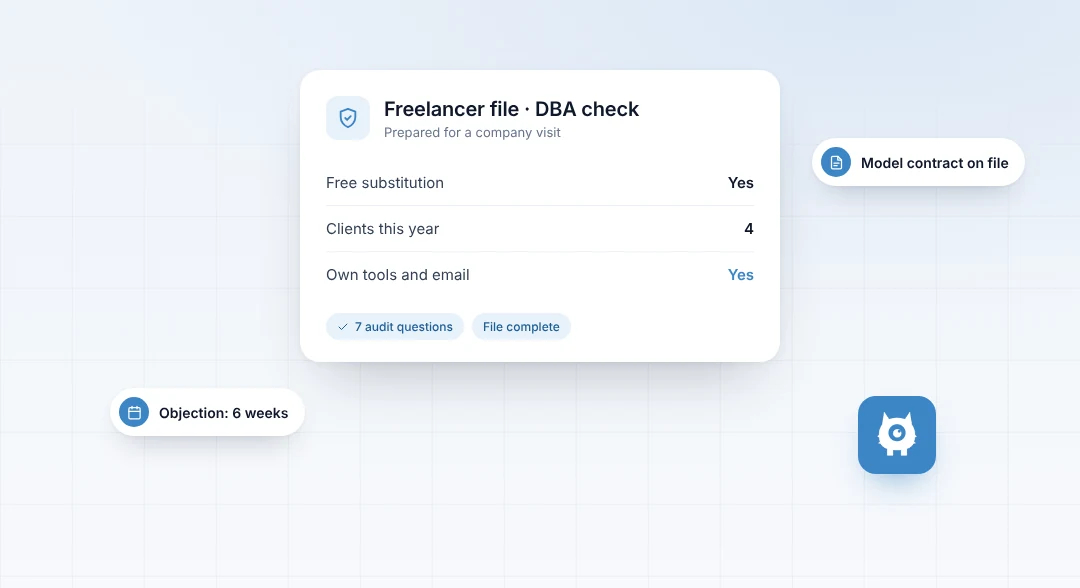
1. Can the freelancer be replaced by someone else?
Legal basis: Personal performance of work is a defining feature of employment (BW art. 7:610). A genuine self-employed contractor must in principle be able to send a qualified substitute without the hiring client's prior consent. Since Deliveroo this is one of the most heavily weighted criteria.
Red flag: Substitution requires the hiring client's prior approval; only specific named individuals may substitute; substitution suspends or terminates the engagement.
Safe statement of fact: Substitution is permitted by a qualified third party without prior approval; the hiring client sets only qualification requirements (diploma, experience, certification), not personal-identity requirements.
File evidence to keep: A written substitution clause in the agreement plus, where applicable, examples of actual use over the past 12 months (substitution during holiday or illness).
2. Who decides how the work is performed?
Legal basis: Employer authority (BW art. 7:610) is the right to give instructions on how the work is carried out. A hiring client may specify the result; an employer may prescribe the process. The Belastingdienst examines instruction emails, attendance at team meetings, fixed working hours, and performance reviews.
Red flag: Fixed working hours or required physical presence; daily or weekly instructions; attendance at team meetings; performance and appraisal interviews; inclusion in performance cycles.
Safe statement of fact: The freelancer decides how and when the work is performed. The hiring client specifies only the result (delivery, quality criteria, deadline). Communication runs through formal hand-off and delivery moments, not daily supervision.
File evidence to keep: An assignment description with SMART results and clear delivery criteria; archived email correspondence without process instructions; absence of invitations to performance reviews.
3. Does the freelancer work for several clients?
Legal basis: Entrepreneurship for income tax purposes (Wet IB 2001 art. 3.4, read with the criteria from the Belastingdienst's Handboek Ondernemen) requires, among other things, several clients, own acquisition activity, and commercial risk. A single long-term client points strongly to employment.
Red flag: Single client; exclusivity clause; relationship of more than 70% of annual turnover with one client; absence of active acquisition or website; no Chamber-of-Commerce marketing activity.
Safe statement of fact: The freelancer has invoiced at least three different clients during the current year; no exclusivity clause; demonstrable acquisition activity through website, LinkedIn, network, or platform.
File evidence to keep: Chamber-of-Commerce extract; filtered invoice overview showing the number of distinct clients; URL of the freelancer's website or professional profile; agreements with other clients.
4. How is the freelancer paid?
Legal basis: Wages (a fixed periodic payment independent of performance) are a defining feature of employment. An entrepreneur invoices per assignment or per hour worked at a rate that covers entrepreneurial risk. The law adopted on 18 June 2026 (Staatsblad 2026, 158, article 7:610aa BW) enters into force on 31 December 2026 and creates a legal presumption of employment for low hourly rates: the statute names EUR 36, the government separately communicated EUR 38 (reference date 1 January 2026); the amount for first application is still to be set by ministerial regulation, consult the current text for the definitive application.
Red flag: Fixed monthly amount independent of hours worked or result delivered; continued payment during illness or holiday; holiday allowance; year-end bonus; commuting allowance equivalent to that of employees; hourly rate below the legal-presumption threshold.
Safe statement of fact: Payment by invoice per assignment or per hour worked, at a rate demonstrably above the legal-presumption minimum that covers entrepreneurial costs and risk. No continued payment during illness or holiday. No holiday allowance or thirteenth-month payment.
File evidence to keep: Invoice overview with variable amounts or time sheets; rate justification (cost-price calculation including insurance, pension, training budget); supplemental disability insurance in the freelancer's name.
5. Who provides the working tools?
Legal basis: An employee typically receives a laptop, software, office space, and email account from the employer. An entrepreneur invests in their own tools and bears the associated risk. The Belastingdienst examines hardware, software, and digital identity.
Red flag: A complete working environment provided by the hiring client: laptop with hiring-client imaging, badge, fixed desk with name plate, email address within the hiring-client domain, listing on the organisation chart or telephone directory.
Safe statement of fact: Own laptop and software; access to hiring-client systems only where functionally necessary, with separate guest or consultant credentials; own email address within the freelancer's domain; no fixed desk or badge.
File evidence to keep: Purchase receipts for laptop and software licences in the freelancer's name; email correspondence via the freelancer's domain; absence of a personal workspace at the hiring client.
6. Is the freelancer embedded in the organisation?
Legal basis: Embedding in the organisation (attending staff outings, listing in the organisation chart, wearing company branded clothing) points to employment. A genuine entrepreneur delivers a result to a contact person and is not a functional part of an internal team.
Red flag: Permanent place in the organisation chart; participation in staff outings and Christmas-package distribution; company branded clothing; job title on business card or email signature; access to internal HR systems.
Safe statement of fact: The freelancer works on a project basis, delivers hand-off moments to a single point of contact, and does not appear on the organisation chart or staff list. No participation in staff events in an employee role.
File evidence to keep: Organisation chart with no mention of the freelancer; email signature that clearly identifies the freelancer status; absence from HR systems and Christmas-package distribution.
7. How long has the freelancer worked for this client?
Legal basis: An uninterrupted long-term relationship points to employment, especially in the absence of concurrent assignments and a defined end date. The Deliveroo ruling explicitly cites duration as one of the weighted criteria.
Red flag: Uninterrupted relationship of more than two years without clearly defined sub-assignments; automatic annual renewal without a renewed assignment confirmation; agreement for an indefinite period without concrete delivery criteria.
Safe statement of fact: Each assignment has a defined end date or a clear delivery moment; new assignments require a renewed assignment confirmation; the freelancer works in parallel or alternation for other clients.
File evidence to keep: Assignment confirmations with start and end dates per assignment; delivery documents per phase; invoice frequency that reflects the project nature; agreements with overlapping or sequential other clients.

What does reclassification cost the hiring client?
Financial damage has three components: the back assessment of payroll tax and social premiums, any deliberate-misclassification fine (from 1 January 2026 also for gross negligence) and tax interest. The income tax that the freelancer has already paid through their own IB return is in principle not levied twice, but the employer-side costs fall on the hiring client.
Example: a hiring client engages one ZZP'er for 80,000 euros per year (invoice amount excluding VAT) over 12 months. On reclassification to employment:
- Employer share of social premiums (Awf, WIA, Zvw contribution), approximately 21% of gross wages: 16,800 euros
- Pension contribution employer share (sectoral average 5%): 4,000 euros
- Deliberate-misclassification fine (from 1 January 2026, up to 100% of the back assessment): 20,800 euros
- Tax interest (approximately 6% per year over the back assessment): 1,250 euros
Total damage per ZZP'er per year: approximately 42,850 euros
The back assessment currently reaches back to 1 January 2025; for a hiring client with several misclassifications or a multi-year relationship the total can rise quickly. A hiring client with five ZZP'ers in comparable positions faces potential exposure of 200,000 euros, excluding the further extension of the look-back period expected from 2027.
The file you must keep today
The Belastingdienst assesses the actual practice, not just the agreement. An approved model contract only protects when daily reality follows the contract text. Below the ten file items requested in almost every audit:
- An approved model contract (general or sector model) signed by both parties, with a variant fitting the actual situation.
- A written substitution clause, plus examples of actual use over the past 12 months (substitution during holiday or illness).
- An assignment description per assignment with SMART results, start and end dates, and clear delivery criteria.
- A Chamber-of-Commerce extract for the freelancer, plus agreements with at least two other clients in the current year.
- An invoice overview over the past 12 months with variable amounts and invoices to multiple clients.
- A rate justification: a cost-price calculation showing that the hourly rate covers entrepreneurial costs and risk (insurance, pension, training, entrepreneur deductions).
- Purchase receipts or lease contracts for working tools in the freelancer's name (laptop, software licences, where relevant office space).
- Insurance policies in the freelancer's name: disability insurance and professional liability insurance.
- An independence declaration per assignment in which the freelancer confirms that they are free to work for other clients.
- Communication via formal assignment channels, no work instructions through daily email or team chat; absence of invitations to performance reviews.
How Taxmo Kantoor supports DBA preparation
An accountant supporting several corporate clients that engage ZZP'ers benefits from a structured file per client and a unified view of DBA risk across the portfolio. In Taxmo Kantoor you do that with:
- Client tags such as "DBA risk high" or "ZZP hiring client". Filter the client list by tag, scope reports, target newsletters, and plan audit-preparation conversations only for the relevant clients.
- NBA 4410 and 2400 dossier with permanent file: store model contracts, substitution clauses, and independence declarations permanently so they remain available in every subsequent financial year after the year-end roll-over. Lock-on-submit ensures the file cannot be modified after submission.
- Client knowledge update with risk-based cadence (Wwft art. 8 and broader client review): low-risk clients every 24 months, medium 12, high 6. Clients that engage ZZP'ers can be auto-placed in the high-risk cadence.
- Objection workflow with automatic Awb deadline (six weeks after the assessment date, art. 6:7 Awb): your client receives a back-assessment notice, you log it, Taxmo computes the deadline and flags overdue files on the office dashboard.
- AI Studio with the tax-question assistant: ask a Wet DBA question, receive a substantiated answer with explicit reference to law and case law (Wet DBA, BW art. 7:610, Hoge Raad ruling Deliveroo).
- Append-only audit log: every change in the client file is recorded with actor, entity and timestamp. Seven-year retention in accordance with AWR art. 52 lid 4. Inspection-ready for both a Wet DBA audit and an NBA disciplinary procedure.
Frequently asked questions about Wet DBA audits in 2026
When did the Wet DBA enforcement moratorium end?
The enforcement moratorium ran until 31 December 2024. From 1 January 2025 the Belastingdienst can issue payroll-tax back assessments (naheffingen loonheffing) to companies that hire freelancers who actually qualify as employees. The look-back period extends gradually; in 2026 a back assessment can reach back to 1 January 2025.
What is the difference between a vergrijpboete and a verzuimboete?
A vergrijpboete (10% to 100% of the back assessment) applies in cases of deliberate misclassification or gross negligence. From 1 January 2026 the Belastingdienst can impose this on hiring clients who cannot demonstrate they took reasonable care. A verzuimboete (administrative fine for objective errors without intent) remains suspended in 2026 under the so-called soft landing.
Which criteria does the Belastingdienst use during a Wet DBA audit?
Since the Hoge Raad's Deliveroo ruling (24 March 2023) the Belastingdienst applies a holistic test. No single criterion is decisive in isolation; all circumstances of the engagement are weighed. Core criteria: authority relationship, personal performance of work (free substitution), number of clients, entrepreneurial risk, embedding in the organisation, duration of the engagement, and ownership of the work tools.
How much does reclassifying a ZZP'er to an employee cost the hiring company?
A company that engages a ZZP'er for 80,000 euros per year and is later reclassified can expect approximately 24,000 to 28,000 euros per year of employer-side back assessment (employer share of social premiums plus any pension contribution). From 2026 a deliberate-misclassification fine of up to 100% can be added, plus tax interest. The back assessment currently reaches back to 1 January 2025; for a multi-year contract the exposure can quickly run to 60,000 to 100,000 euros per ZZP'er.
Does an approved model contract protect against reclassification?
Not automatically. An approved model contract (modelovereenkomst) only provides certainty when the working relationship in practice follows the contract text. If the day-to-day reality diverges (instructions, fixed hours, restricted substitution), the engagement is still classified as employment. The Belastingdienst assesses the actual practice, not just the agreement.
How far back can a payroll-tax back assessment reach?
Currently a back assessment reaches back to 1 January 2025. The cabinet has announced gradual extension of the look-back period toward the statutory five-year maximum; this extension is expected from 1 January 2027 or later.
Can a hiring company file an objection against a back assessment?
Yes. Under the Algemene wet bestuursrecht (Awb art. 6:7) the hiring company has six weeks from the assessment date to file an objection. A pro forma objection is permitted; the grounds may be supplied later within a reasonable period. Appeal against the decision on objection lies with the Rechtbank, with further appeal to the Gerechtshof.


