






New to freelancing in the Netherlands? Understanding Dutch VAT (BTW) is an important part of managing your business finances. This beginner-friendly guide explains how VAT works, which rates apply, when to charge VAT, how to reclaim eligible VAT on business expenses, and how to prepare and file your VAT return.
Dutch VAT explained: A beginner’s guide for freelancers
You've just landed your first freelance client in the Netherlands. You've agreed on a €1,000 fee, completed the project, and you're ready to send your first invoice.
But wait, do you need to add VAT? And if your client pays €1,210 instead of €1,000, is that extra €210 yours to keep?
If you're a freelancer or self-employed professional (ZZP'er) with a business established in the Netherlands, this guide is for you. We'll explain how Dutch VAT (BTW) works, when to charge it, what you can reclaim, and how to prepare for your VAT return.
Dutch VAT at a glance
VAT (BTW) is a tax applied to most goods and services in the Netherlands. Here's what freelancers established in the Netherlands need to know:
- Standard VAT rate: 21% for most products and services.
- Reduced VAT rates: 9% or 0% for certain goods and services.
- Charging VAT: Most freelancers charge VAT on their invoices unless an exemption or special arrangement applies.
- VAT on expenses: You can generally reclaim VAT on eligible business purchases.
- VAT returns: Most freelancers file VAT returns quarterly, reporting the VAT they charged and the VAT they can deduct.
- VAT payments: You generally pay the difference between the VAT owed on your sales and the deductible VAT on your business expenses.
What is VAT (BTW) in the Netherlands?
VAT is a tax added to most goods and services in the Netherlands. In Dutch, it’s called BTW, short for belasting over de toegevoegde waarde.
As a freelancer, you generally collect VAT from your customers on behalf of the Dutch Tax Administration (Belastingdienst).
Let’s break down how it works:
- You provide a service or sell a product
- You charge the applicable VAT on your invoice
- Your customer pays the total amount, including VAT
- You report the VAT in your VAT return and pay the amount due after deducting eligible input VAT
For example, if you charge €1,000 for a web-design project and apply the 21% VAT, your client pays €1,210. However, the additional €210 isn’t a part of your earnings. It is VAT you have collected and have to account for.
VAT is also different from income tax.
VAT generally applies to the goods and services you sell, while income tax applies to your taxable income. As a freelancer, you may have obligations for both.
Do you need to charge VAT as a freelancer?
This guide is specifically for freelancers and self-employed professionals (ZZP'ers) who have established their businesses in the Netherlands. If your business is based in another country, different VAT rules may apply.
Most freelancers established in the Netherlands are required to charge VAT, although exceptions exist. Whether you need to charge VAT depends on your activities, VAT status, and any applicable exemptions.
Before sending your first invoice, check the following:
- Are you considered an entrepreneur for VAT purposes?
- Is your service or product subject to Dutch VAT?
- Are your activities exempt from VAT?
- Are you participating in the small businesses scheme (KOR)?
- Is your client based in the Netherlands or abroad?
What about VAT exemptions and the KOR?
Some activities, including certain healthcare, education and financial services, may be exempt from VAT.
The Netherlands also has a small businesses scheme called the kleineondernemersregeling (KOR).
Businesses established in the Netherlands with an annual turnover of no more than €20,000 may qualify for this scheme, subject to its conditions.
If you're participating in the KOR, you generally don't charge VAT to customers. However, you also cannot reclaim VAT on your business purchases.
For example, if you're planning to buy a laptop or other expensive equipment for your business, joining the KOR could mean missing out on reclaiming the VAT on those purchases. That's why it's worth considering your expected expenses before deciding whether the scheme is right for you.
You can read more about the KOR and its conditions on the Belastingdienst website.
Which Dutch VAT rate should you use?
The Netherlands has three main VAT rates: 21%, 9% and 0%. The correct rate depends on what you're selling and, in some cases, where your customer is located.
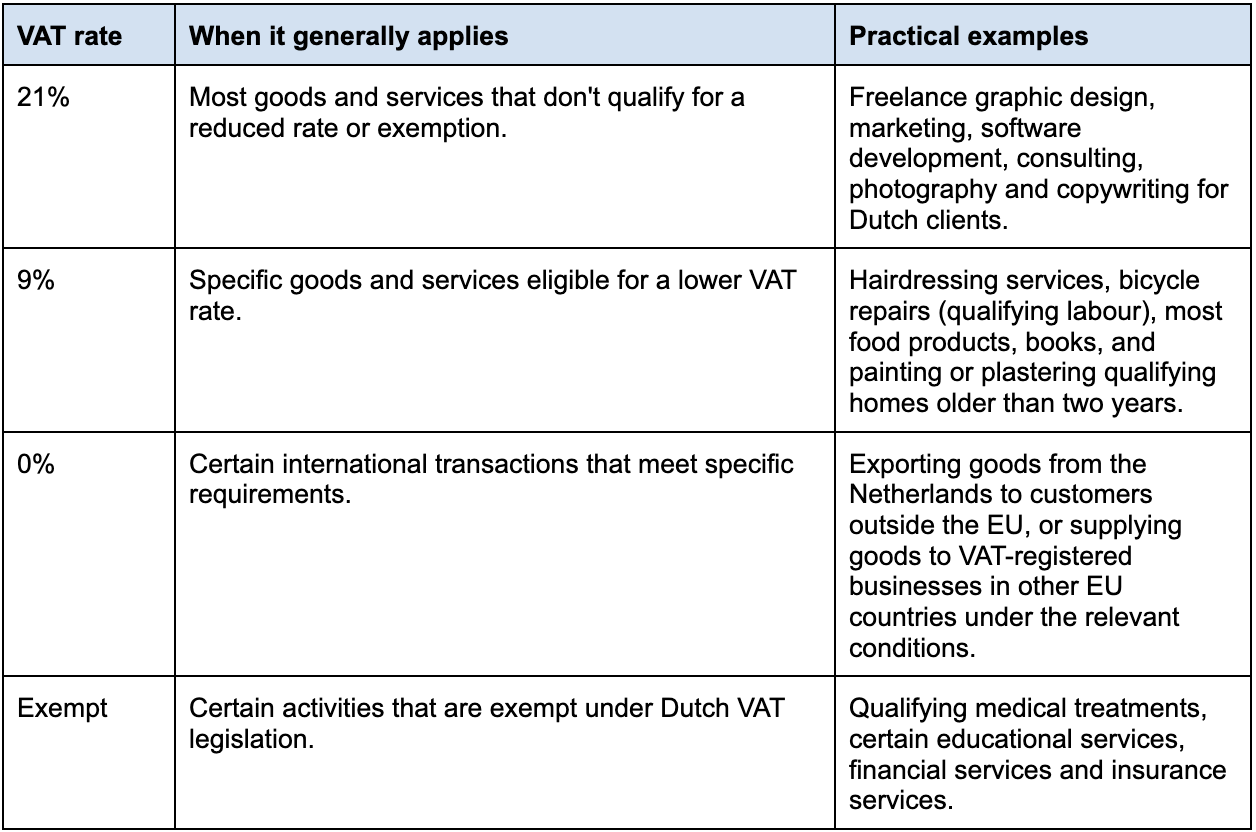
The 0% rate and an exemption are not the same. We'll explain the difference below.
Important: These examples are not universal rules for every transaction. For example, a freelance photographer's ordinary Dutch assignment generally falls under 21%, but a particular transaction may qualify for different treatment. Similarly, not every educational service is VAT-exempt.
When does the 21% VAT rate apply?
The standard Dutch VAT rate is 21% and applies to most goods and services in the Netherlands. For freelancers offering services such as graphic design, marketing, consulting or software development to Dutch clients, this is generally the rate they will charge.
If you're unsure which VAT rate applies to your work, 21% is the standard rate to check first, but it shouldn't be applied automatically. Certain goods and services qualify for reduced rates or exemptions, which we'll explain below.
When do the 9% and 0% VAT rates apply?
The reduced 9% VAT rate applies only to specific goods and services, while the 0% rate generally applies to certain international transactions and other qualifying activities.
For example, a freelance hairdresser generally charges 9% VAT for hairdressing services, while a freelance consultant typically charges 21% for services provided to Dutch clients.
The 0% rate works differently. A Dutch business exporting goods outside the EU may qualify for 0% VAT, provided the relevant conditions are met.
Not sure which rate applies to your business? Check the Belastingdienst's official overview of VAT rates before sending your invoice.
What is the difference between 0% VAT and a VAT exemption?
Although both mean you don't charge VAT to your customer, 0% VAT and VAT exemptions are not the same.
With the 0% rate, your transaction is still considered VAT-taxable, meaning you can generally reclaim eligible VAT paid on related business expenses.
With a VAT exemption, you generally cannot reclaim VAT on expenses related to those exempt activities.
For example, a business making qualifying zero-rated exports may still deduct eligible VAT on its business purchases. However, a healthcare professional providing VAT-exempt treatments generally cannot reclaim VAT on expenses related to those treatments.
This distinction can make a real difference to your business costs.
How do you add VAT to an invoice?
To add VAT to an invoice, calculate the applicable VAT percentage on your fee excluding VAT, then add it to the total.
Let's continue with our freelance designer example.
You've completed the €1,000 logo design project and need to send your invoice.
Your calculation is:
- Service fee: €1,000
- VAT (21%): €210
- Total payable: €1,210
But what if you've agreed on a price that already includes VAT?
In this case, you need to calculate how much of the total is VAT rather than adding it on top.
To calculate 21% VAT included in a price:
VAT amount = Total price × 21 / 121
For example, if you've agreed on a total price of €1,210 including VAT:
- VAT amount: €1,210 × 21 / 121 = €210
- Price excluding VAT: €1,210 − €210 = €1,000
This way, you can show the correct VAT amount on your invoice without accidentally charging your client extra.
What should your invoice include?
For a standard Dutch VAT invoice, make sure you include:
- Your business name and address.
- Your customer's name and address.
- Your VAT identification number (btw-id).
- Your KVK number, if registered.
- A unique, sequential invoice number.
- The invoice date.
- The date the service or product was supplied.
- A clear description of the work.
- The amount excluding VAT.
- The applicable VAT rate and VAT amount.
- The total amount payable.
Include your payment details and payment deadline as well, so your client knows how and when to pay.
How much VAT should you set aside and pay?
A practical approach is to set aside the VAT amount shown on your invoices rather than treating it as business income. This helps ensure you have enough available when your VAT payment is due.
However, the amount you eventually pay to the Belastingdienst may be lower because you can deduct VAT on eligible business expenses.
For example, imagine that during one quarter:
- VAT charged on your sales: €630
- Deductible VAT on business expenses: €105
- VAT payable: €630 − €105 = €525
In this case, you would pay €525 rather than the full €630, assuming there are no other VAT adjustments.
A simple habit that can help
Consider keeping the VAT amount from your invoices in a separate savings account or dedicated balance. This can help you avoid accidentally spending money you may need for your VAT payment.
Remember that VAT reporting doesn't always depend on when your client pays. Under the standard invoice-based system (factuurstelsel), VAT is generally reported based on invoices issued during the relevant VAT period, even if the customer hasn't paid yet.
Can you reclaim VAT on business expenses?
Yes, you may be able to reclaim Dutch VAT on business expenses used for activities that are subject to VAT. This is called input VAT, or voorbelasting in Dutch.
For example, if you purchase business software or equipment and pay VAT on it, you may be able to deduct that VAT from the amount you owe on your VAT return.
However, not every purchase qualifies.
You generally need a valid VAT invoice and must use the purchase for activities that allow VAT deduction. If something is used partly for personal purposes, you may need to restrict the amount you reclaim.
Businesses providing VAT-exempt services or participating in the KOR generally cannot deduct input VAT relating to those activities.
How does reclaiming VAT affect your VAT return?
Let's continue with our freelance designer:
You collected €210 VAT from your client. During the same VAT period, you also purchased qualifying business software for €100 excluding VAT. The software cost you €121, including €21 VAT.
Assuming the €21 VAT on your software is fully deductible, you can subtract it from the €210 VAT you collected from your client.
€210 (VAT collected) − €21 (VAT on expenses) = €189 VAT payable.
So, instead of paying €210 to the Belastingdienst, you would only need to pay €189 for that period, assuming these were your only relevant transactions.
If your deductible input VAT is higher than the VAT you owe for the period, you may be entitled to a VAT refund.
Do you charge VAT for clients outside the Netherlands?
When working with international clients, you don't always charge Dutch VAT. For cross-border transactions, the correct VAT treatment depends on where your customer is based, whether they're a business or consumer, and what goods or services you provide.
Different rules may apply to digital services, physical goods, and services supplied to businesses in other EU countries or outside the EU.
Before sending the invoice, check:
- Where is your customer based? Are they in the Netherlands, another EU country or outside the EU?
- Are they a business or a private customer? Different VAT rules can apply.
- What are you supplying? Goods and services can be treated differently.
What is reverse-charge VAT?
In some situations, VAT is reverse-charged (btw verlegd), meaning your customer accounts for the VAT instead of you charging it on your invoice.
For example, imagine you're a Dutch freelance designer creating a €1,000 logo for a VAT-registered company in Germany. For this type of service, you would generally invoice €1,000 without Dutch VAT.
Before sending the invoice, check your client's VAT number using the EU's VIES checker. Include both VAT identification numbers and the wording "VAT reverse-charged" (btw verlegd) on your invoice. You'll also need to report the transaction in your Dutch VAT return and Opgaaf ICP.
However, not every international transaction qualifies for reverse charging.
For more information, see the Belastingdienst's guidance on services to customers in other EU countries.
When and how do you file a Dutch VAT return?
Your VAT return tells the Belastingdienst:
- How much VAT you've charged on your sales during the reporting period.
- How much VAT you can deduct on eligible business expenses.
- Whether you need to pay VAT or are entitled to a refund.
Let's return to our freelance designer example.
During the quarter, you issued an invoice with €210 VAT and had €21 in deductible VAT on business expenses.
Assuming these were your only relevant transactions, your VAT return would show €189 payable.
Under the standard invoice-based VAT system (factuurstelsel), you generally report VAT based on when you issue your invoices, even if your clients haven't paid yet.
How do you check your filing frequency and deadlines?
Check your assigned filing period in Mijn Belastingdienst Zakelijk. The Belastingdienst determines whether you file monthly, quarterly or annually.
For businesses established in the Netherlands that file quarterly, the following deadlines apply to 2026:
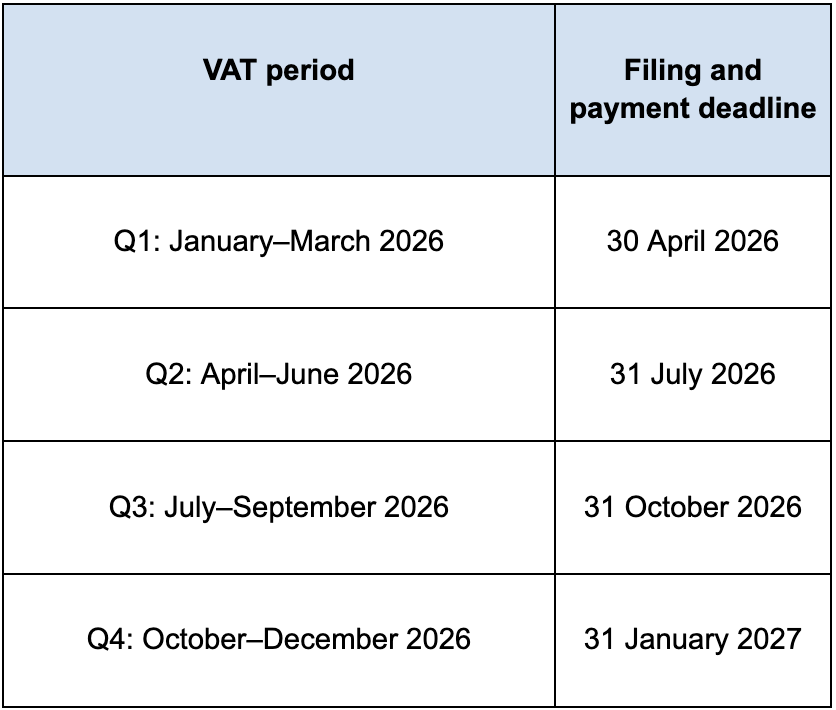
Both your VAT return and the payment must reach the Belastingdienst by the applicable deadline.
Importantly, submitting your VAT return and paying your VAT are two separate actions.
Submitting a return doesn't automatically mean you've paid the amount due.
These dates apply to the standard quarterly system for businesses established in the Netherlands. Special rules and different deadlines may apply to certain businesses.
You can check the official VAT filing and payment deadlines here.
What do you need before filing?
Before filing your VAT return, make sure your sales and purchase records are complete.
A simple checklist:
- All invoices sent to clients during the relevant period.
- The VAT amounts charged on those invoices.
- Invoices and receipts for business expenses.
- The VAT amounts eligible for deduction.
- Records of credit notes or corrections.
- Records of international transactions, if applicable.
- Your VAT identification and filing information.
For many freelancers, the time-consuming part isn't completing the VAT return itself. It's finding missing receipts, checking invoices and calculating the correct amounts.
Keeping these records organised throughout the quarter can make filing considerably easier.
Do you need to file if you had no sales?
Yes, if you're required to submit VAT returns, you generally still need to file even when you've made no sales.
If you had no sales and no other transactions to report, you would usually submit a nil VAT return (nihilaangifte).
If you had no sales but purchased eligible business supplies, your return may still contain deductible input VAT.
Certain exemptions and special schemes, including the KOR, can change your filing obligations.
The important thing is to check whether the Belastingdienst expects a return from you.
Don't simply skip a filing period because your business hasn't generated revenue.
Read the Belastingdienst's explanation of VAT returns without turnover.
What happens if you file or pay late?
Filing or paying your VAT late can result in penalties, so it's important to act quickly if you've missed a deadline.
For late filing, the standard VAT filing penalty is currently €82, subject to the applicable rules.
Late or insufficient payment can result in a separate penalty. The exact amount depends on the circumstances and applicable rules.
If you've already missed a deadline:
- Submit your outstanding VAT return as soon as possible.
- Check the amount you owe.
- Arrange payment promptly.
- Review any letters or assessments from the Belastingdienst.
- Contact the Belastingdienst if you cannot pay or need help understanding your situation.
If the Belastingdienst has issued an estimated assessment because you didn't file, submitting the actual figures is particularly important.
For details, see the official guidance on late VAT returns and late VAT payments.
How Taxmo helps you keep track of VAT
Taxmo is an online bookkeeping and tax platform designed to help freelancers and self-employed professionals (ZZP'ers) in the Netherlands manage their business finances. Instead of keeping invoices, receipts, expenses, and VAT calculations in separate places, you can organise everything in one platform and use that information to prepare your VAT return.
Create invoices and keep track of business expenses
With Taxmo, you can create and manage invoices, record business expenses, and keep your financial records organised throughout the year.
You can also upload receipts directly through the platform or send them using Taxmo's WhatsApp Expense Inbox. This makes it easier to keep the documents you need for your bookkeeping and potential VAT deductions.
Automatically calculate and review your VAT
When it's time to prepare your VAT return, Taxmo uses your recorded income and expenses to calculate the VAT on your sales and purchases.
Taxmo's VAT filing guide displays the calculated amounts in the relevant Dutch VAT return categories, including sales at different VAT rates and deductible VAT on business expenses.
You can review these amounts and see your total VAT payable or refundable before filing. This reduces the need to calculate and organise everything manually.
Submit your VAT return directly to the Belastingdienst
Once you've checked your VAT figures and completed the required business details, you can submit your VAT return directly from Taxmo to the Belastingdienst through Digipoort, the official Dutch government gateway.
If you prefer to file the return yourself, Taxmo also provides a step-by-step VAT filing guide. It automatically fills in the calculated amounts for the relevant return categories, which you can use when completing your return through the Belastingdienst portal.
The benefit? Less time spent sorting through receipts, calculating VAT, and transferring figures between different tools, so you can focus more on running your business.
Explore Taxmo's bookkeeping and VAT features at taxmo.nl/features.
Frequently asked questions about Dutch VAT
Is BTW the same as VAT?
Yes. BTW is simply the Dutch term for VAT. It stands for belasting over de toegevoegde waarde, meaning value-added tax.
What is the difference between a VAT number and a KVK number?
A KVK number identifies your business in the Dutch Chamber of Commerce register, while a VAT identification number identifies you for VAT purposes.
They're used for different administrative purposes, and registered businesses may need to include both on their invoices.
Where can I find my Dutch VAT identification number?
Your VAT identification number (btw-id) is provided by the Belastingdienst.
You can find it in the relevant correspondence from the tax authority and in Mijn Belastingdienst Zakelijk.
Make sure you use the correct VAT identification number on invoices rather than confusing it with your VAT tax number (omzetbelastingnummer).
Is VAT the same as income tax?
No. VAT generally relates to the goods and services you sell, while income tax is calculated on your taxable income.
Freelancers may need to file both VAT returns and annual income tax returns.
Can I reclaim VAT on costs incurred before starting my business?
Sometimes, yes. VAT on qualifying expenses incurred while preparing to start your business may be deductible, even if the purchases were made before KVK registration.
You must meet the relevant VAT conditions and retain appropriate supporting invoices.
For example, a laptop purchased specifically while preparing to start your freelance business may qualify, depending on its use and your VAT status.
See the Belastingdienst – Costs incurred during the startup phase
Belastingdienst
What should I do if I make a mistake on a VAT return?
You can correct an incorrect VAT return, but the method depends on the size of the error.
For VAT errors of €1,000 or less, you can generally make the correction in your next VAT return.
For errors exceeding €1,000, you generally need to submit a VAT correction (suppletie btw).
Different rules or additional obligations may apply depending on the circumstances.
Consult the Belastingdienst's instructions for correcting VAT returns.
Belastingdienst
Final thoughts: Make VAT one less thing to worry about
Dutch VAT might seem complicated when you're preparing your first invoice, but understanding a few basic principles makes a big difference.
Remember:
- Check whether you need to charge VAT before invoicing.
- Use the correct rate for your product or service.
- Keep the VAT you collect separate from your earnings.
- Save invoices and receipts for eligible business expenses.
- Know your filing deadlines and keep your records organised.
And most importantly, don't wait until the end of the quarter to start thinking about VAT.
With the right habits and tools, you can spend less time worrying about administration and more time growing your freelance business.
Want to make VAT and bookkeeping easier? Explore Taxmo and see how it can help you manage your business finances.


