






If you're a ZZP'er in the Netherlands, every invoice you send must meet strict Belastingdienst requirements. Get even one element wrong and your client loses their BTW deduction, and the Belastingdienst can issue penalties. This guide walks you through the 7 required elements, explains the BTW-id vs OB-nummer difference, VAT rates, the KOR scheme, and how to invoice EU clients step by step.
What Are the 7 Required Elements on a Dutch Invoice?
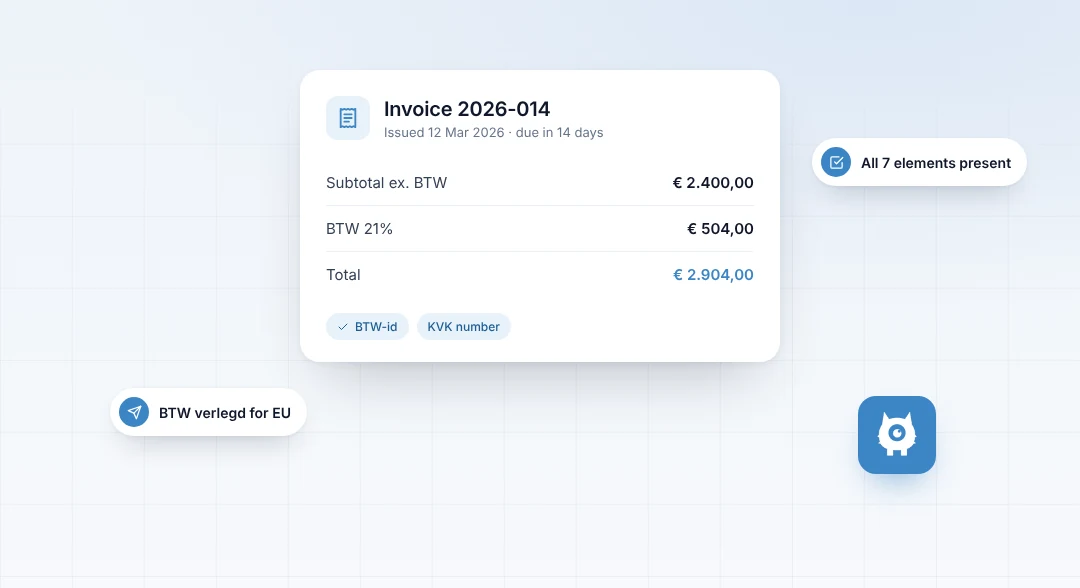
Every invoice you send as a Dutch freelancer must include 7 elements per Belastingdienst rules. Missing even one can mean the buyer loses their right to deduct BTW, and the Belastingdienst can issue penalties for incorrect invoices. Don't worry, once you know the list, it becomes second nature.
1. Date of issue (factuurdatum)
The date the invoice is created. This determines which BTW period the invoice falls under.
2. Sequential invoice number (factuurnummer)
A unique, unbroken sequence with no gaps. For example: 2026-001, 2026-002, 2026-003. Gaps trigger questions from the Belastingdienst.
3. Your business details
Your full legal name or business name, address, and KVK (Chamber of Commerce) number.
4. Your BTW-identificatienummer
This is the number that goes on invoices - NOT the OB-nummer. Format: NL + 9 digits + B + 2 digits.
5. Client details
The client's full name or business name and address. For B2B transactions within the EU, you also need their VAT identification number.
6. Description of goods or services
A clear description of what you delivered, including quantity and unit price. Vague descriptions can be rejected.
7. VAT breakdown
The amount excluding BTW, the applicable BTW rate(s), the BTW amount per rate, and the total amount including BTW - all shown separately.
What's the Difference Between BTW-id and OB-nummer?
This is the most confusing part for Dutch freelancers - and getting it wrong is a serious privacy risk. The Belastingdienst introduced the separate BTW-id in 2020 specifically to protect sole traders' BSN from being shared on every invoice. This trips up almost every new freelancer, so if you're confused, you're not alone.
BTW-identificatienummer (BTW-id)
Goes ON your invoices
- Format: NL + 9 digits + B + 2 digits (e.g. NL123456789B01)
- Does NOT contain your BSN
- Safe to share with clients, on your website, and on invoices
- Introduced in 2020 to protect sole traders' privacy
Omzetbelastingnummer (OB-nummer)
For tax filings ONLY
- Format: 9 digits + B + 2 digits (e.g. 123456789B01)
- For eenmanszaken: the first 9 digits ARE your BSN
- NEVER put this on an invoice - identity fraud risk
- Only used for BTW filings with the Belastingdienst
If you have an eenmanszaak and you put the OB-nummer on your invoices, every client receives your BSN. This is a direct identity fraud risk. Always use your BTW-identificatienummer instead.
Which VAT Rate Should You Charge as a ZZP'er?
The Netherlands has three BTW rates plus certain exemptions. As a ZZP'er, you need to know which rate applies to your services - charging the wrong rate is a common reason for corrections during a Belastingdienst audit.
21%: Standard rate (standaardtarief)
Most services and products. This is what the vast majority of ZZP'ers charge. If you're unsure, this is likely your rate.
9%: Reduced rate (verlaagd tarief)
Food and beverages, books and e-books, medications, some home renovation work, and cultural events. Note: hotels and short-stay accommodation moved to 21% on 1 Jan 2026.
0%: Zero rate (nultarief)
Exports to countries outside the EU. Intra-EU supplies to VAT-registered businesses (intracommunautaire levering/dienst).
Exempt: BTW-exempt (vrijgesteld)
Education, healthcare, financial services, and insurance. You do not charge BTW, but you also cannot deduct any input BTW on your expenses.

Should You Register for the KOR (Small Business VAT Exemption)?
The Kleineondernemersregeling (KOR) is a VAT exemption for small businesses. If your annual revenue stays below €20,000 (excluding BTW), you can opt in - but there are trade-offs you should understand before registering. Most freelancers deal with this decision at some point - take your time to weigh the pros and cons.
Advantages of KOR
- You don't charge BTW on your invoices - simpler for clients
- No quarterly BTW returns to file
- Less administrative burden overall
- Attractive for small-scale freelancers with low expenses
Disadvantages of KOR
- You cannot deduct input BTW on purchases and expenses
- After you leave, you cannot rejoin for the rest of that year and the next
- If you exceed €20,000 in a year, you exit KOR immediately and must start charging BTW
- Must be registered - it's not automatic
Note: KOR invoices must include the exemption text: "BTW vrijgesteld op grond van artikel 25 Wet op de omzetbelasting 1968." Without this text, the invoice is incomplete.
Tip: Not sure if KOR is right for you? Use the Taxmo KOR Advisor to calculate whether opting in saves you money or costs you. To register for KOR, submit the form 'Melding Kleineondernemersregeling' via the Belastingdienst portal at mijn.belastingdienst.nl.
How Do You Invoice EU Clients as a Dutch Freelancer?
When you invoice B2B clients in other EU countries, the standard VAT rules shift. Instead of charging Dutch BTW, you apply the reverse charge mechanism (verleggingsregeling) - the VAT liability transfers to your client in their country.
How reverse charge works:
1. Charge 0% BTW
You do not charge Dutch VAT. The invoice shows 0% BTW.
2. Include "BTW verlegd"
Your invoice must explicitly state "BTW verlegd" (Dutch) or "VAT reverse charged" (English).
3. Add client's VAT ID
The invoice must include your client's VAT identification number for their country.
4. File ICP declaration
You must file an Opgaaf Intracommunautaire Prestaties (ICP declaration) with the Belastingdienst for the relevant period.
Non-EU: For non-EU clients, the service is generally subject to the 0% rate, but the specific treatment depends on the type of service. Digital services to non-EU consumers follow separate rules. When in doubt, check with a tax advisor (belastingadviseur).
What Are the Most Common Invoicing Mistakes (and How to Avoid Them)?
These are the errors the Belastingdienst sees most often - and the ones most likely to cost you money or trigger an audit. Avoid them and your administration stays clean. These mistakes are more common than you'd think - and most are easy to fix once you know about them.
1. Using the OB-nummer instead of BTW-id
This exposes your BSN on every invoice you send. It's a serious identity fraud risk and one of the most common mistakes new freelancers make.
2. Gaps in invoice numbering
The Belastingdienst expects a sequential, unbroken series. Gaps (e.g. going from 2026-003 to 2026-007) raise questions and can trigger an audit.
3. Missing or incorrect VAT breakdown
You must show the amount excluding BTW, the BTW rate, the BTW amount, and the total including BTW - all separately. A single total is not enough.
4. Not including your KVK number
Your KVK number is required on all business correspondence, including invoices. It's a legal requirement that many freelancers overlook.
5. Forgetting reverse charge text for EU clients
Without "BTW verlegd" on the invoice, your EU client cannot reclaim the VAT in their country. This creates problems for both parties.


