






Dutch tax rules for freelancers changed significantly in 2026. Whether you're worried about the lower zelfstandigenaftrek (self-employed deduction), the new Box 1 rates, or the scrapped Wet VBAR, this guide covers exactly what changed, what it means for your wallet, and what you need to do about it.
How Did Income Tax (Inkomstenbelasting) Change for ZZP'ers in 2026?
New Box 1 Rates
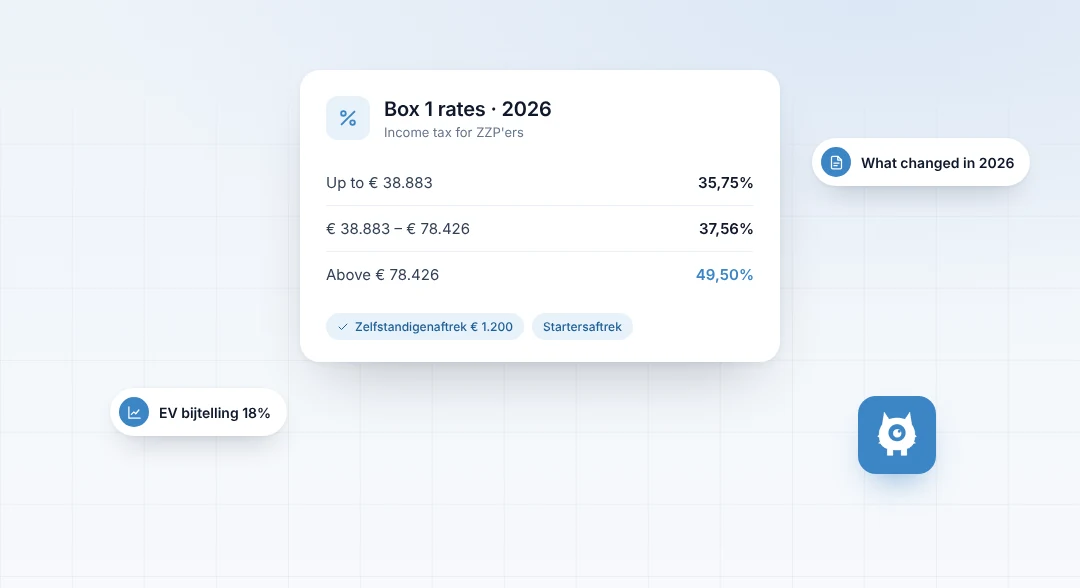
As a freelancer with an eenmanszaak (sole proprietorship), you pay inkomstenbelasting (income tax) on your profit in Box 1. Both the thresholds and the percentages have been adjusted for 2026:
- Up to €38,883: 35.75%
- €38,883 - €78,426: 37.56%
- Above €78,426: 49.50%
The combined effect means most freelancers will pay slightly more income tax in 2026. Note: the bracket-1 rate is 35.70% income tax; combined with national insurance contributions, some sources publish this as 35.75%. Indexed thresholds for 2026 vary slightly between sources, so always verify against the official Belastingdienst tables before filing.
Zelfstandigenaftrek (Self-Employed Deduction)
The ongoing phase-out continues. The deduction drops to €1,200 in 2026, down from €2,470 in 2025. This means less tax benefit for meeting the urencriterium (1,225 hours/year).
Because the zelfstandigenaftrek is shrinking, the urencriterium (1,225-hour requirement) becomes less important. If you’re a part-time freelancer who doesn’t hit the hours, you’re not missing out on as much anymore.
Startersaftrek: For 2026 the startersaftrek remains at €2,123 (available in your first 3 of 5 years as an entrepreneur), but it is currently planned to be abolished from 1 January 2027. The zelfstandigenaftrek is also scheduled to drop again to €900 in 2027. The MKB-winstvrijstelling stays at 12.70%.
Box 3: Wealth Tax
Box 3 applies to your private wealth (savings, investments), not business assets. The tax-free threshold has increased to €59,357 per person (up from €57,684 in 2025).
Updated deemed return rates:
- Bank savings: 1.28% (was 2.44%)
- Investments & other assets: 6% (was 5.88%)
- Debts: 2.7% (was 2.62%)
The planned increase to 7.78% for investments was dropped, so the deemed return stays at 6%.
What Changed for Electric Company Cars in 2026?
Bijtelling (Private Use Surcharge)
If you use a business car privately (more than 500 km/year), you pay 22% bijtelling (private use surcharge). For new electric cars in 2026, a reduced rate applies:
- First €30,000: 18%
- Above €30,000: 22% (standard rate)
This rate locks in for 5 years from first registration. If you wait until 2027, the rate will likely be 20%.
Motor Vehicle Tax (MRB)
The MRB discount for emission-free passenger cars drops to 30% (valid through 2028). The discount for electric vans is completely eliminated.
Planning to buy an electric van? Factor in the full MRB cost from 2026 onward. The subsidy era for electric commercial vehicles is effectively over.
What Are the New BTW and Cash Payment Rules?
Accommodation VAT Rate
The BTW rate on logies (accommodations) such as hotels, B&Bs, and vacation rentals has increased to the standard 21% rate. If you provide accommodation services or expense business stays, note the higher VAT.
Cash Payment Ban Above €3,000 (Trade in Goods)
As of January 1, 2026, it is illegal for traders to accept cash payments of €3,000 or more for goods. The ban targets the professional buying or selling of goods for €3,000 or more (including aggregated partial payments) and is designed to combat money laundering. ZZP’ers buying goods personally aren’t affected, but if you buy or sell goods professionally above the threshold, the ban applies.
If you trade goods professionally and accept large cash payments, you must switch to bank transfers or digital payments. Keep your records clean and digital.

What Happened to the Wet DBA and Wet VBAR?
This is the one that’s been keeping freelancers up at night. This has been stressful for many freelancers, here’s where things actually stand.
Wet DBA: Enforcement Continues (Softly)
The Wet DBA (Deregulering Beoordeling Arbeidsrelaties) is designed to combat schijnzelfstandigheid (false self-employment). The Belastingdienst has been actively checking since 2025, but the “zachte landing” (soft landing) approach has been extended into 2026. In practice, fines are only imposed in extreme cases of deliberate abuse. If you’re unsure about your status, consult a tax advisor to review your working relationship.
Wet VBAR: Partly Scrapped, Rechtsvermoeden Kept
The Wet VBAR was supposed to clarify who’s a freelancer and who’s really an employee. It was expected mid-2026.
March 2026 update: Per the cabinet decision of 6 March 2026: only the clarification part of Wet VBAR was scrapped. The rest of the legislation is being split:
- The rechtsvermoeden (legal presumption of employment for ZZP work below a set hourly rate) was enacted: Staatsblad 2026, 158 (new article 7:610aa BW), and enters into force on 31 December 2026, with no transitional provision for existing contracts. The statute sets the threshold at EUR 36/hour; the cabinet has also communicated EUR 38/hour (reference date 1 January 2026), but no ministerial regulation fixing the applicable amount has been published, so verify the current figure on the official source. It is not a minimum hourly rate, it is a threshold that shifts the burden of proof to the client; you can still legally work below it.
- The cabinet has said it intends to address the clarification of employment relationships in a separate, later law (sometimes referred to as the Zelfstandigenwet), but no bill text has been published, only an announced intention. Until such a law exists, classification of a working relationship is governed by case law alone: the Hoge Raad judgments of 24 March 2023 and 21 February 2025.
What This Means for You
The legal landscape for freelancers remains uncertain, but enforcement is real. Make sure your working relationship genuinely looks like freelancing. Check with an accountant if you’re unsure:
- Work for multiple clients
- Set your own hours and work location
- Take business risk (liability, investment)
- Invest in your own equipment and training
- Keep your contracts aligned with reality
What Should You Do Right Now as a ZZP'er?
With all these changes, here’s what you should focus on. You don’t need to do everything at once. Start with the items that affect you most.
1. Update your tax projections
The new Box 1 rates and lower zelfstandigenaftrek will change your tax bill. Use Taxmo to see the impact in real time.
2. Review your hourly rate
The rechtsvermoeden threshold enters into force on 31 December 2026 (statute: EUR 36/hour; the cabinet has also cited EUR 38/hour, verify the applicable amount on the official source). Working below it shifts the burden of proof to your client, it is not a minimum rate. Make sure your contracts and working pattern back up genuine self-employment if you price below that threshold.
3. Audit your contracts
Do they reflect genuine self-employment? Multiple clients, own equipment, business risk, no organizational integration? Document it.
4. Check your EV plans
2026 still offers 18% bijtelling on the first €30K. Waiting until 2027 means 20%.
5. Get your bookkeeping in order
With the cash ban and stricter enforcement, clean digital records are more important than ever. Taxmo tracks your BTW, expenses, and deductions automatically.


